

The retreat center is in a geographic area with high incidence of tick-borne Lyme disease. Instead of relating with fear and aversion, we practice relating wisely to the unavoidable risks that come with being at the retreat center. As a way of taking care of ourselves and all those sharing the space with us, we expect everyone to take the necessary precautions to greatly reduce the chance of infection and bringing ticks into the building. Please read the following tick info carefully and commit to the following procedures.
The tiny blacklegged (deer) ticks that carry Lyme disease and other serious illnesses are prevalent in our area. It’s important that you protect yourself. The following suggestions are adapted from the CDC.
General Information
Ticks can attach to any part of the human body but are often found in hard-to-see areas such as the groin, armpits, and scalp. In most cases, the tick must be attached for 36 to 48 hours or more before the Lyme disease bacterium can be transmitted. In general, adult ticks are approximately the size of a sesame seed and nymphal ticks are approximately the size of a poppy seed.
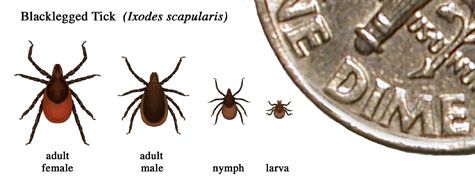
From the CDC: “In areas of the eastern United States where Lyme disease cases are common, people may be bitten by blacklegged ticks carrying bacteria from spring through the fall. From April through July, nymphs are actively questing for hosts in the environment, and in early spring and fall seasons, adults are most active. Nymphal ticks pose a particularly high risk due to their abundance and small size, which makes them difficult to see. Lyme disease patients are often not even aware of a tick bite before getting sick. Adult female ticks also can transmit the bacteria but are more likely to be noticed and removed before transmission due to their larger size.”
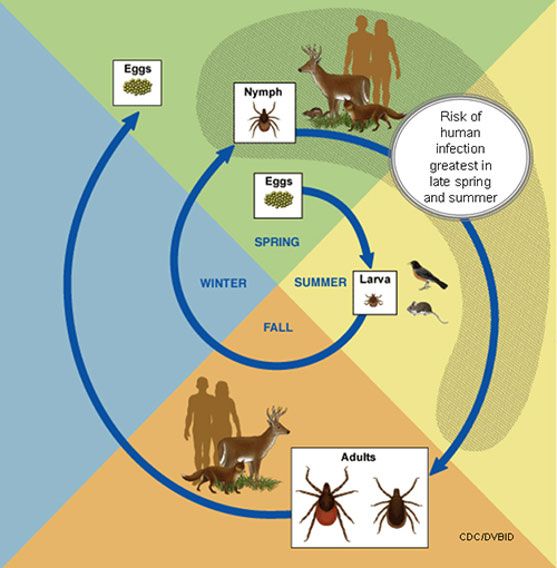
Blacklegged ticks have a 2-to-3-year life cycle. During this time, they go through four life stages: egg, larva, nymph, and adult.
Before You Go Outdoors
Ticks live in wooded or grassy areas and leaf litter. Always walk in the center of trails in order to avoid contact with ticks. Tuck your pants into your socks to thwart ticks from climbing up your pants legs. We recommend you wear light-colored clothing, especially pants, to make it easier to see ticks.
Products containing permethrin kill ticks. Permethrin can be used to treat boots, clothing and camping gear and remain protective through several washings. We have permethrin-soaked white socks at the retreat center. If you plan to walk on the mowed grass or on the trails in the woods you are agreeing to wear the permethrin-coated socks that are kept in a green metal bin in the entryway. You can reuse a pair during your stay and then put them in the appropriately labeled bucket in the laundry room before you leave. The socks are to be worn over your normal socks and over your pant legs.
We also have insect repellent (but feel free to bring your own!) Use a repellent with DEET on skin. Repellents containing 20% or more DEET (N, N-diethyl-m-toluamide) can protect up to several hours. Always follow product instructions. Avoid hands, eyes, and mouth.
People are strongly encouraged to also spray permethrin or insect/tick repellent on the shoes that you plan to use when walking on the mowed grass and on the trails in the woods. Please read the directions on the bottle carefully. Allow shoes to dry thoroughly before using. Do the permethrin application away from other people, for example in the middle of the parking lot, and spray upwind so you are not exposed to the mist. If you like spending a lot of time in the woods or taller grass or gardens you should probably consider treating one pair of pants and a shirt with permethrin to be used for all outdoor walks and activities.
If you are going to do any work in higher grass or brush we are asking you to wear the permethrin-coated overalls (over your regular clothing) that are hanging in the barn; you should also wear permethrin socks over the pant legs of the overalls, and make sure to have previously treated your shoes. Please change back to your indoor clothes in the barn.
For campers, please use permethrin socks and spray your shoes with either permethrin or insecticide. Leave your shoes outside your tent, or if you bring them in, put them in a bag inside your tent.
After You Come Indoors
Whenever you walk on the mowed grass or on the trails in the woods you are agreeing to doing a tick check before coming into the building. There are sticky rollers in the west entrance that can be rolled over your pants. If you were in a place where you brushed up against a lot of plants it might be best to leave a clean set of clothing in the barn and then change your clothes in the barn after your walk. Your outdoor set of clothes can be put in a sealed bag to be used on other days.
Check your clothing for ticks. Any unattached ticks that are found should be removed with a tissue or paper napkin and either walked down the road and released, away from humans, or killed by flushing it down the toilet.
For all people spending time walking on the mowed grass and in the woods, please plan to shower within 24 hours of your walk. Showering within two hours of coming indoors has been shown to reduce your risk of getting Lyme disease. Bring a rough washcloth or even better a loofah sponge or even an abrasive dish sponge (or if you forget to bring one you can pick one up in the first-aid cabinet in the laundry room). While showering, use the loofah or abrasive sponge to scrub roughly all areas of the body to dislodge any ticks. This is also a good opportunity to do a tick check, using the mirrors in the bathroom.
Use a hand-held or full-length mirror to view all parts of your body. Check these parts of your body for ticks:
- Under the arms
- In and around the ears
- Inside the belly button
- Back of the knees
- In and around the hair
- Between the legs
- Around the waist
Again, any unattached ticks that are found should be removed with a tissue or paper napkin and either walked down the road and released, away from humans, or killed by flushing it down the toilet.
How to Remove an Attached Tick
(Oft-suggested methods of heating or applying nail polish are not recommended.)
- Use fine-tipped tweezers to grasp the tick as close to the skin's surface as possible.
- Pull upward with steady, even pressure. Don't twist or jerk the tick; this can cause the mouth parts to break off and remain in the skin. If this happens, remove the mouth parts with tweezers. If you are unable to remove the mouth easily with clean tweezers, leave it alone and let the skin heal.
- After removing the tick, either kill it by flushing it down the toilet or walk it down the road and release it away from humans. Thoroughly clean the bite area and your hands with rubbing alcohol, an iodine scrub, or soap and water.
Signs and Symptoms of Lyme Disease
Watch for signs of illness such as rash or fever in the days and weeks following the bite and see a healthcare provider if they develop. Untreated, Lyme disease can result in serious complications.
Some people get a small bump or redness at the site of a tick bite that goes away in one to two days, like a mosquito bite. This is not a sign that you have Lyme disease.
Early localized stage (3-30 days post-tick bite)
- Fatigue, chills, fever, headache, muscle and joint aches, and swollen lymph nodes.
- Red, expanding rash called erythema migrans (EM). The rash occurs in 70%-80% of infected persons. The rash gradually expands over a period of several days, and can reach up to 12 inches across. Parts of the rash may clear as it enlarges, resulting in a “bulls-eye” appearance. The rash is seldom itchy or painful.
Early disseminated stage (days to weeks post-tick bite)
Untreated, the infection may spread from the site of the bite to other parts of the body, producing an array of specific symptoms that may come and go, including:
- Additional EM lesions in other areas of the body
- Facial or Bell's palsy (loss of muscle tone on one or both sides of the face)
- Severe headaches and neck stiffness due to meningitis (inflammation of the spinal cord)
- Pain and swelling in the large joints (such as knees)
- Shooting pains that may interfere with sleep
- Heart palpitations and dizziness due to changes in heartbeat
Many of these symptoms will resolve over a period of weeks to months, even without treatment. However, lack of treatment can result in additional, serious complications.